DPF Diagnostics
Pinpoint DPF system issues before they become costly breakdowns - advanced diagnostics, detailed reports, and expert recommendations.
Comprehensive DPF System Diagnostics Using State-of-the-Art Equipment
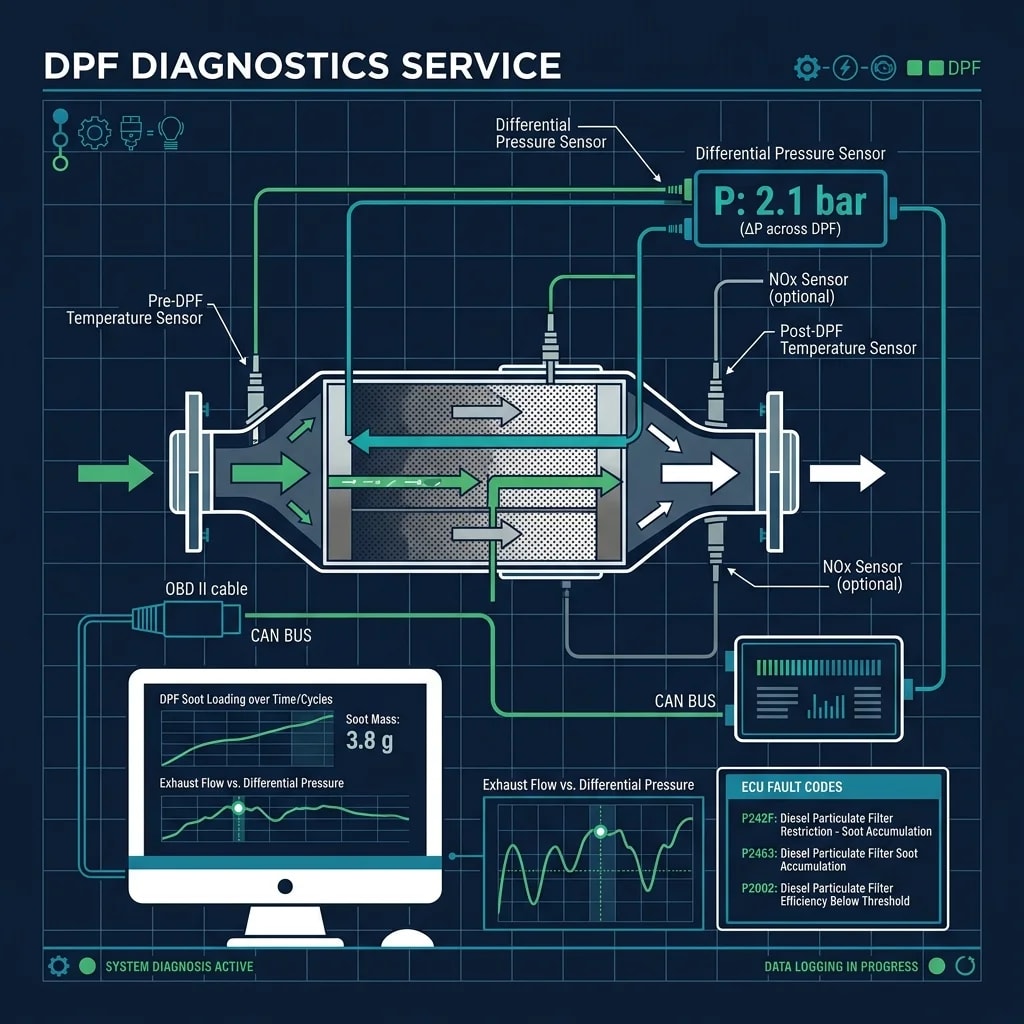
Our DPF diagnostic service goes far beyond reading fault codes. We perform a full system analysis - measuring differential pressure across the filter, verifying sensor accuracy, analysing ECU data streams, and running flow tests - to give you a complete picture of your diesel particulate filter system health. Our detailed written report tells you exactly what is wrong, what caused it, and the most cost-effective way to fix it.
- Differential pressure testing across the DPF
- Complete ECU fault code analysis and data logging
- DPF sensor calibration and accuracy verification
- Exhaust back-pressure measurement
- Diesel Oxidation Catalyst (DOC) efficiency assessment
- Detailed written diagnostic report with repair recommendations
Benefits of Our DPF Diagnostics
Industry-leading service backed by expertise, technology, and reliability
Accurate Root Cause
We identify the exact cause of DPF system faults - not just symptoms - so you only pay for the fix you need.
Prevent Costly Failures
Early detection of DPF issues prevents engine damage, forced regeneration failures, and expensive breakdowns.
EPA-Certified Testing
All diagnostics are performed by certified technicians using calibrated, professional-grade equipment.
Detailed Reporting
You receive a comprehensive written report - ideal for fleet records, insurance claims, and warranty disputes.
How It Works
Our streamlined process ensures quality results with minimal downtime
Fault Code Scan
We connect to the truck ECU and pull all active and historic DPF-related fault codes for analysis.
Pressure & Flow Testing
Differential pressure is measured across the DPF under load to determine restriction level accurately.
Sensor Verification
All DPF sensors (pressure, temperature, NOx) are verified for accuracy and calibrated if needed.
System Assessment
DOC efficiency, SCR function, and exhaust system integrity are all evaluated as part of the full check.
Report & Recommendation
You receive a clear, written report outlining findings and the most cost-effective repair path.
Frequently Asked Questions
Common questions about our DPF Diagnostics service
Our DPF diagnostic service includes: ECU fault code scanning and data logging, differential pressure testing across the filter, DPF sensor calibration and verification, exhaust back-pressure measurement, DOC efficiency assessment, and a detailed written report with findings and repair recommendations.
If your DPF warning light is on or you have recurring regeneration failures, diagnostics is the right first step. It determines whether the issue is a clogged filter (requiring cleaning), a faulty sensor, an ECU programming problem, or an underlying engine issue causing excessive soot production. Cleaning without diagnosis risks missing the root cause.
Yes. Our system-wide assessment evaluates the full aftertreatment system including the Diesel Oxidation Catalyst (DOC), Selective Catalytic Reduction (SCR) system, and all associated sensors and wiring. Engine faults that cause excessive soot - such as injector issues or EGR problems - are also flagged in our report.
A comprehensive DPF diagnostic typically takes 1.5–3 hours depending on system complexity and the number of fault codes to investigate. We provide results and recommendations on the same day.
Yes. Our technicians carry portable diagnostic equipment and can perform ECU scanning, pressure testing, and sensor verification at your fleet yard or location. Some tests (such as full flow bench testing) require the truck to be at or near our facility.
Absolutely. Every diagnostic service includes a detailed written report documenting all fault codes found, sensor readings, pressure test results, and our specific repair or service recommendations. This is invaluable for fleet maintenance records and warranty documentation.
A fault code scan simply reads error codes from the ECU - it tells you a warning light is on but not why. A full diagnostic interprets those codes in context, performs physical tests (pressure, flow, sensor checks), and traces the fault back to its root cause. This prevents misdiagnosis and ensures the correct repair is carried out the first time.
Ready to Book Your DPF Diagnostics?
Expert service is just a call away. Choose your preferred way to connect with us and get your truck back to peak performance.