
EGR Cleaning
Remove carbon and soot buildup from your Exhaust Gas Recirculation system - restoring fuel economy, reducing NOx emissions, and protecting your engine.
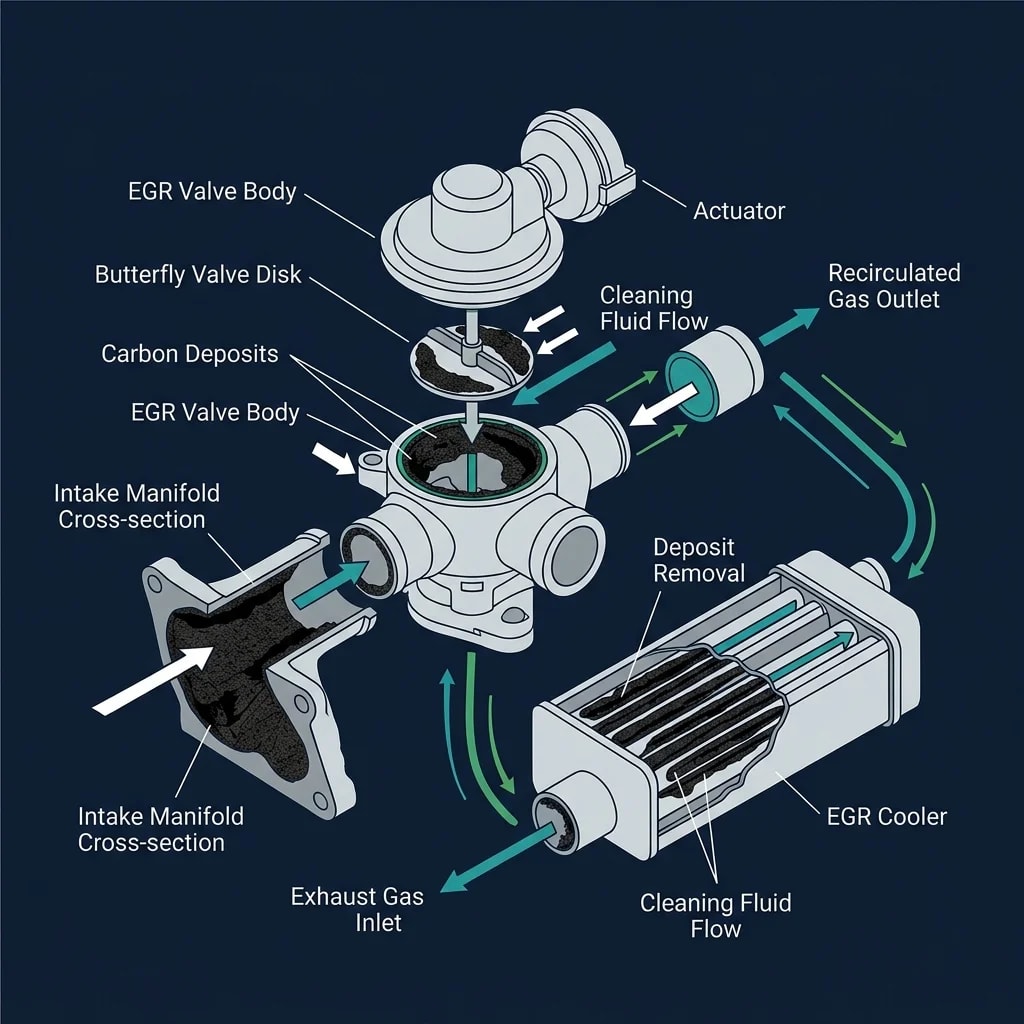
Professional Exhaust Gas Recirculation (EGR) Valve and Cooler Cleaning Service
The Exhaust Gas Recirculation (EGR) system reduces NOx emissions by recirculating a portion of exhaust gases back into the intake. Over time, heavy carbon deposits accumulate on the EGR valve, cooler passages, and intake manifold - restricting flow, reducing efficiency, and causing the valve to stick or fail. Our professional EGR cleaning service removes these deposits thoroughly, restoring correct EGR flow rates, improving fuel economy, and preventing the expensive failures that follow from blocked or seized EGR components.
- Complete EGR valve carbon and soot deposit removal
- EGR cooler internal passage cleaning to restore heat exchanger efficiency
- Intake manifold de-coking as part of the EGR clean
- EGR valve operation test - flow and response verified post-cleaning
- Fault code clearing and EGR position sensor calibration
- Reduces NOx emissions and protects the downstream DPF from excess soot
Benefits of Our EGR Cleaning
Industry-leading service backed by expertise, technology, and reliability
Restored EGR Flow
Cleaning removes the carbon restrictions that choke EGR flow, restoring it to factory-specified rates.
Improved Fuel Economy
A stuck or restricted EGR causes fuel-to-air ratio imbalance - cleaning often results in measurable fuel savings.
Prevent Costly Failure
An EGR valve seized open or closed causes misfires, overheating, and DPF damage. Cleaning prevents this.
Protects the DPF
A poorly functioning EGR increases soot load on the DPF. Cleaning the EGR reduces DPF clogging frequency.
How It Works
Our streamlined process ensures quality results with minimal downtime
EGR System Scan
ECU fault codes are read and EGR valve position and flow data are logged to baseline the system condition.
Component Removal
The EGR valve, cooler, and relevant intake manifold sections are carefully removed for thorough cleaning.
Carbon Removal
Heavy carbon deposits are removed from the valve body, cooler tubes, and manifold using safe, targeted methods.
Flow Verification
EGR valve operation, flow rate, and cooler efficiency are tested post-cleaning against OEM specification.
Reinstallation & Report
Components are reinstalled, faults cleared, and a service report with before/after flow data is provided.
Frequently Asked Questions
Common questions about our EGR Cleaning service
The Exhaust Gas Recirculation (EGR) system channels a controlled portion of exhaust gases back into the engine's intake manifold. This dilutes the oxygen-rich intake charge and reduces peak combustion temperatures, which in turn lowers NOx (nitrogen oxide) emissions. Because exhaust gases carry soot, hydrocarbons, and oil vapour, heavy carbon deposits accumulate on the EGR valve, cooler passages, and intake manifold walls over time - especially in stop-and-go city driving conditions.
Key symptoms include: check-engine light with EGR-related fault codes (P0400, P0401, P0402, etc.), rough idle or engine misfires, poor throttle response, reduced fuel economy, increased black smoke from the exhaust, engine overheating (from EGR cooler blockage), increased DPF regeneration frequency, and - in severe cases - engine damage from a stuck-open EGR valve flooding the intake with exhaust gases.
No. Cleaning removes the carbon deposits that are causing the EGR valve to stick, restrict, or malfunction without replacing the component. In many cases, cleaning fully restores EGR function at a fraction of the cost of replacement. However, if the valve itself has suffered mechanical damage (broken actuator, cracked body, warped seating surface), replacement may be required. Our inspection determines which applies before any work begins.
Yes - this is one of the most common causes of premature DPF clogging. A malfunctioning EGR system alters the combustion air-to-fuel ratio, producing excess soot that loads the DPF faster than designed. If your DPF is requiring cleaning more frequently than normal, an EGR system inspection is strongly recommended to identify whether the EGR is contributing to the problem.
Yes, measurably in most cases. A partially blocked or stuck EGR valve disrupts the engine's optimal fuel-to-air ratio, leading to incomplete combustion, increased fuel consumption, and additional soot production. Once EGR flow is restored to the correct rate, combustion efficiency improves - and most drivers report a noticeable improvement in fuel economy following cleaning.
Yes. The EGR cooler is cleaned as part of our standard EGR service. The cooler's internal passages can become blocked with carbon and soot deposits, reducing heat exchange efficiency and potentially causing coolant contamination in severe cases. We inspect and clean both the valve and cooler together.
For most Class 6–8 diesel trucks, EGR system cleaning is recommended every 150,000–200,000 miles under normal highway driving conditions. For trucks operating in stop-and-go city cycles, or those that idle frequently, we recommend inspection every 100,000 miles. If you are experiencing any of the symptoms described above, have the EGR inspected regardless of mileage.
Ready to Book Your EGR Cleaning?
Expert service is just a call away. Choose your preferred way to connect with us and get your truck back to peak performance.