
Turbocharger Cleaning
Remove carbon deposits from your turbocharger vanes and actuator - restoring full boost pressure, power output, and fuel economy without expensive turbo replacement.
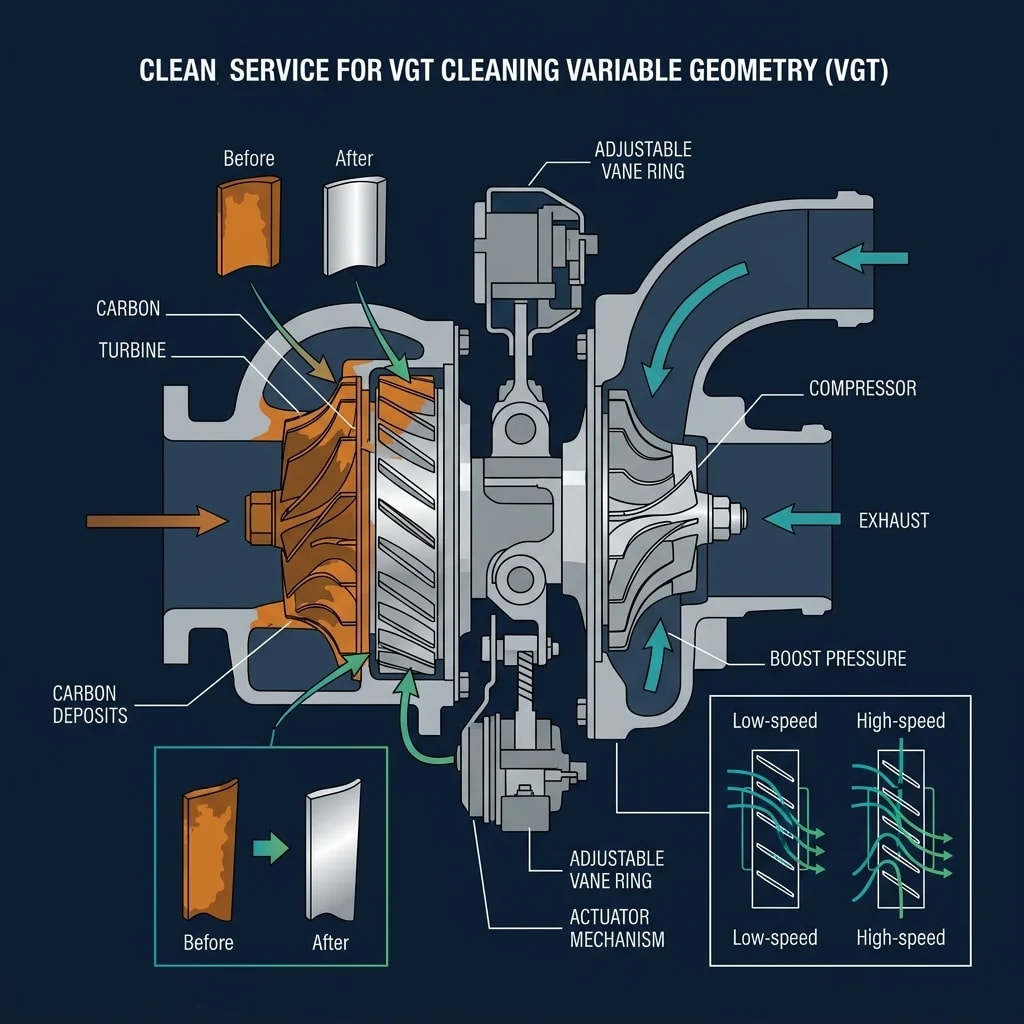
Professional Turbocharger Carbon Deposit Removal That Restores Boost and Power
The turbocharger is under constant thermal stress - and over time, carbon deposits accumulate on the variable geometry vanes (VGT), nozzle rings, actuator mechanism, and housing. These deposits restrict vane movement, reduce boost efficiency, and can cause the turbo to stick in a single position. Our professional turbocharger cleaning service removes these carbon deposits safely and thoroughly, restoring full vane movement, optimising boost control, and returning your engine to its rated power output - without the cost of turbo replacement.
- Variable geometry (VGT) vane and nozzle ring carbon removal
- Turbo actuator cleaning and range-of-motion restoration
- Compressor and turbine housing de-coking
- Boost pressure and VGT response verification post-cleaning
- Actuator calibration and ECU adaptation reset
- Safe process - does not damage turbo bearings or seals
Benefits of Our Turbocharger Cleaning
Industry-leading service backed by expertise, technology, and reliability
Restored Boost Pressure
Cleaning frees stuck VGT vanes and restores the turbo's ability to deliver rated boost across the full RPM range.
Better Fuel Economy
A turbo operating at correct boost efficiency means the engine burns fuel more completely, reducing consumption.
Prevent Costly Failure
A seized turbo can cause sudden total failure. Cleaning removes the deposits causing the issue before it escalates.
Expert Service
Our technicians specialise in diesel aftertreatment and forced induction systems on Class 6–8 trucks.
How It Works
Our streamlined process ensures quality results with minimal downtime
Turbo System Scan
ECU fault codes are read and boost pressure, VGT position, and actuator data are logged for a pre-clean baseline.
Turbo Removal
The turbocharger is removed following OEM procedures to prevent damage to oil and coolant connections.
Carbon Removal
Vanes, nozzle ring, actuator mechanism, and housing are cleaned of carbon deposits using targeted, safe methods.
Vane & Actuator Testing
Full vane range of motion and actuator response are verified against manufacturer specification.
Reinstallation & Report
Turbo is reinstalled with fresh seals, actuator calibrated, faults cleared, and a full service report provided.
Frequently Asked Questions
Common questions about our Turbocharger Cleaning service
Diesel engine turbos - particularly Variable Geometry Turbochargers (VGTs) - operate in extremely hot exhaust gas streams. Over time, carbon deposits from combustion and oil vapour accumulate on the variable vanes, nozzle ring, and actuator mechanism. These deposits restrict vane movement (which controls boost level and exhaust braking), reduce turbo efficiency, and in severe cases cause the vane mechanism to seize in one position - triggering turbo faults, power loss, and black smoke.
Common symptoms include: turbo-related fault codes (P0299 underboost, P0234 overboost, VGT position codes), lack of power especially at low RPM, excessive black or blue smoke from the exhaust, poor throttle response, turbo whistle or unusual noise, check-engine or limp mode activation, and visible oil leaks from turbo seals under stress.
In most cases where the turbo fault is caused by carbon deposits on the VGT mechanism (which is extremely common), cleaning is significantly more cost-effective than full turbo replacement. A quality turbocharger replacement for a Class 8 truck can cost $2,500–$5,000 or more including labour. Cleaning typically resolves the same fault at a fraction of that cost. If the turbo has suffered bearing failure or physical damage, replacement may be unavoidable - but our inspection will determine this before any work is quoted.
A VGT (also called a Variable Nozzle Turbine or VNT) uses a ring of adjustable vanes around the turbine wheel to vary the speed and angle of exhaust gas flow. This allows the turbo to deliver strong boost at low RPM and controlled boost at high RPM - improving fuel economy and engine braking. The vane mechanism is operated by a pneumatic or electronic actuator. Carbon deposits act like grit in the mechanism, progressively restricting vane movement until they stick completely.
Chemical on-engine cleaning (sometimes called "turbo cleaning in a can") can address very early-stage deposits with limited effectiveness. For moderate to heavy carbon accumulation - which is typically what causes drivable symptoms and fault codes - physical removal and hands-on cleaning is required to fully clear the vane mechanism and restore proper operation. This is the service we provide.
Turbocharger removal, cleaning, and reinstallation typically takes 4–8 hours for most Class 6–8 truck applications. We aim to have your truck back in service the same day in most cases. Turnaround time will be confirmed at booking once we know the make and model.
Yes. We service turbochargers on all major Class 6–8 diesel trucks and engine brands including Cummins (ISX, X15, ISB), Detroit Diesel (DD13, DD15, DD16), PACCAR (MX-13), Volvo (D13), Mack (MP8), and Navistar (A26) - across all major truck OEMs including Freightliner, Kenworth, Peterbilt, Mack, Volvo, International, and Western Star.
Ready to Book Your Turbocharger Cleaning?
Expert service is just a call away. Choose your preferred way to connect with us and get your truck back to peak performance.